Search is changing.
Users increasingly ask questions directly to AI systems such as ChatGPT, Google AI Overviews, Gemini, Claude, Perplexity, and Copilot rather than clicking through traditional search results.
This shift requires businesses to optimise not only for rankings but for recommendations, citations, and direct answers.
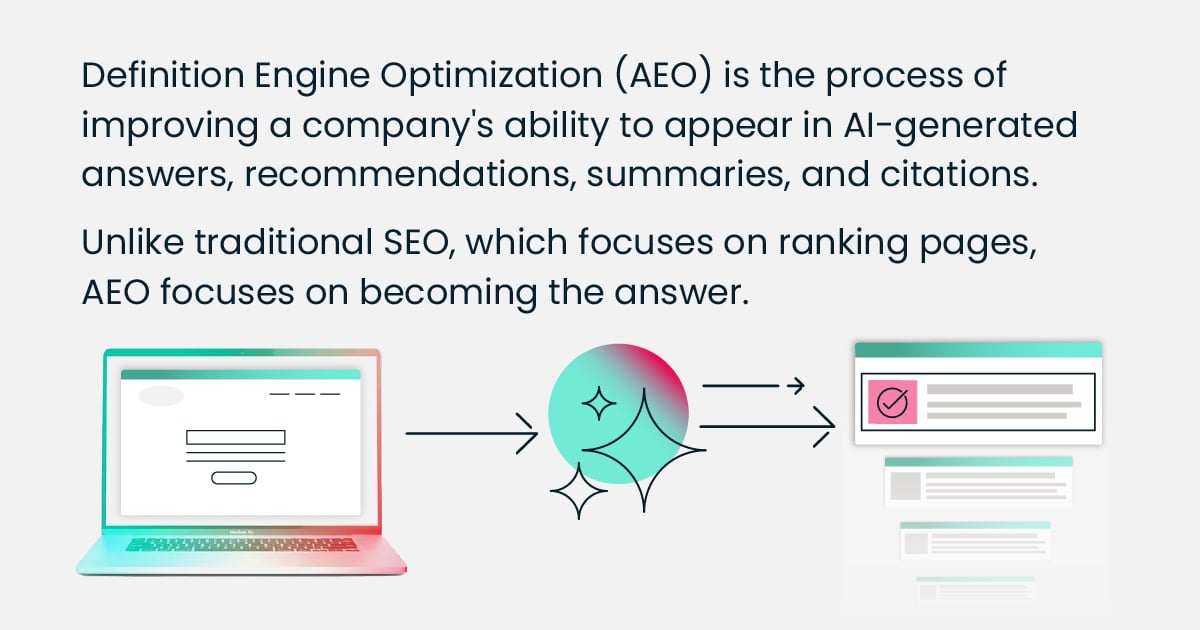
Answer Engine Optimization (AEO) is the practice of structuring content, websites, and brand authority so that AI systems can confidently understand, reference, and recommend a business when answering user queries.
This white paper outlines the core principles of AEO and provides a practical framework organisations can use to improve visibility in AI-generated search experiences.
What is AEO?
The Evolution of Search
Traditional Search:
Query → Results Page → Click
AI Search:
Question → Answer → Recommendation
Why AEO Matters
-
AI-generated search is growing rapidly
-
Users increasingly trust AI summaries
-
Fewer clicks are being sent to websites
-
Brand visibility now depends on citation and recommendation
How AI Systems Evaluate Businesses
AI systems evaluate businesses differently from traditional search engines. While search engines focus largely on relevance and matching keywords to a user's query, AI systems look at a broader set of signals. These signals include:
Trust Signals
-
Contact information
-
Company details
-
Leadership transparency
-
Physical locations
-
Certifications
Authority Signals
-
Expert content
-
Industry publications
-
Original research
-
Case studies
Validation Signals
-
Customer reviews
-
Testimonials
-
Client logos
-
Independent mentions
Technical Signals
-
Structured data
-
Schema markup
-
Crawlable content
-
Site performance
The AEO Framework
A good AEO strategy starts with a solid framework. The four pillars below break down the key areas that AI systems use to assess businesses, giving you a practical structure for building and improving your AEO efforts.
Pillar 1: Entity Authority
Can AI clearly identify who you are?
Requirements:
-
Consistent company naming
-
About page
-
Leadership profiles
-
Organisation schema
-
Knowledge Graph alignment
Pillar 2: Content Authority
Can AI trust your expertise?
Requirements:
-
Industry guides
-
FAQs
-
Thought leadership
-
Research content
-
Use cases
Pillar 3: Proof & Validation
Can AI verify your claims?
Requirements:
-
Case studies
-
Customer outcomes
-
Testimonials
-
Reviews
Certifications
Pillar 4: Technical Readiness
Can AI easily access your information?
Requirements:
-
Schema markup
-
Fast website
-
Structured headings
-
FAQ content
-
Clean site architecture
AEO Content Strategy
Content needs to sit front and centre of your AEO strategy. Rather than focusing just on keywords, the goal is to create content that AI can easily understand, trust, and reference when generating responses.
.jpg?width=736&height=736&name=260617WH01_WH_Social_AEO_Blog_Strategy%20(1).jpg)
Measuring AEO Success
AEO success is measured differently from traditional SEO. Rather than focusing on rankings and clicks, it is important to evaluate how AI systems perceive and recommend your brand. The below metrics will help you measure your AEO performance
-
AI citation frequency
-
AI recommendation visibility
-
Brand mention growth
-
Featured answer appearances
-
Knowledge Graph presence
-
Referral traffic from AI platforms
HubSpot’s new AEO can help with measuring and reporting on these key metrics.
The Future of Search
The organisations that become trusted sources will become the businesses AI systems recommend.
AEO is no longer optional. It is becoming a core component of digital visibility. Download our AEO checklist now to kickstart your AEO strategy.